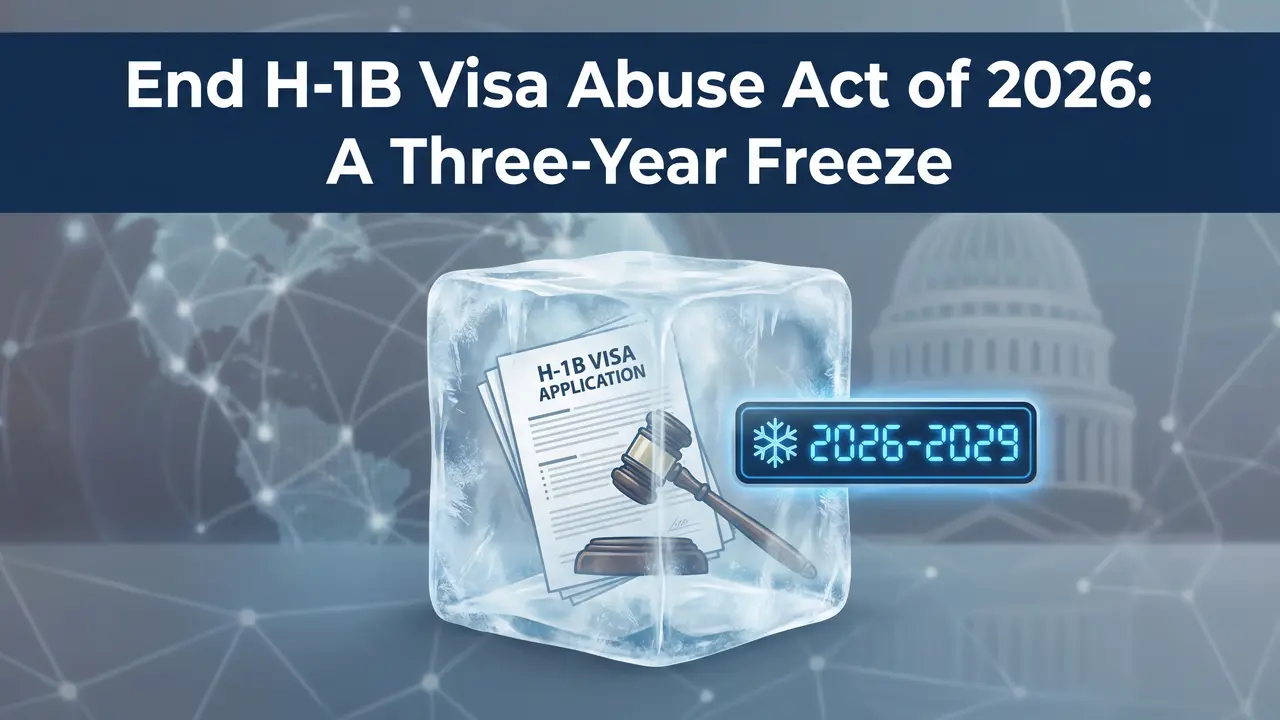
The H-1B visa program, a primary route for skilled foreign workers, is facing what immigration experts call its most aggressive legislative challenge yet. On April 22, 2026, a group of Republican lawmakers introduced the “End H-1B Visa Abuse Act of 2026,” a bill that proposes a dramatic three-year freeze on the issuance of new H-1B visas and a sweeping overhaul of the program. Led by Representative Eli Crane (R-AZ), the bill has garnered the support of seven fellow Republicans, including noted critics Paul Gosar (R-AZ) and Andy Ogles (R-TN). This legislative effort represents the most significant attempt to date to curtail a program that has long been a cornerstone of America’s tech and innovation sectors, and a vital pathway for Indian professionals.
📜 The “End H-1B Visa Abuse Act of 2026”
The bill is structured around two main phases: a complete pause, followed by a drastically redesigned program.
✋ Immediate Action: A Three-Year Freeze
The bill’s most immediate and impactful provision is the call for a halt to the issuance of all new H-1B visas for three years. This “time-out” would allow Congress to evaluate and implement reforms before the program could potentially resume.
🚧 Post-Freeze Reforms: A Radically Different Program
After the three-year pause, the program would be restarted with stringent new requirements:
- Sharply Reduced Cap: The annual quota would be reduced from the current 65,000 to just 25,000, with all existing exemptions eliminated.
- Wage-Based Selection: The current lottery system would be replaced with a wage-based selection process that prioritizes applicants with the highest salaries, in addition to a new minimum salary requirement of $200,000 per year.
- New Employer Mandates: Companies must certify the position cannot be filled by a qualified American worker and that they have not conducted recent layoffs of U.S. staff for similar roles.
- Dependent Restrictions: H-1B workers would be barred from bringing their dependents (spouses and children) to the United States, ending the H-4 visa program.
- Employment Restrictions: H-1B workers would be barred from holding multiple jobs, and third-party staffing agencies would be prohibited from employing them, ending contract-based placements.
🔗 Other Major Overhauls
The bill’s impact extends well beyond the H-1B category itself:
- Ending the H-1B-to-Green Card Pipeline: H-1B holders would be prohibited from transitioning to permanent residency, preventing them from seeking a green card and strictly reinforcing the visa’s “temporary” nature.
- Abolishing OPT: The Optional Practical Training (OPT) program, which allows international students to work in their field of study for 12-36 months after graduation, would be terminated.
- Restricting Federal Agencies: Federal agencies would be barred from sponsoring or employing H-1B workers.
- Mandatory Departure for Status Changes: Nonimmigrants would be required to physically leave the U.S. before changing to another nonimmigrant visa category (e.g., from an F-1 student visa to an H-1B visa).
🎯 A Direct Blow to Indian Professionals
Indian professionals, who receive around 70% of all H-1B visas, would be the most affected group.
- Decimated Opportunities: The combined effect of the three-year freeze, the drastically reduced cap, and the 200,000salaryfloorwouldclosethedoorfornearlyallnewIndianapplicants.Forcontext,theaverageH−1BsalaryintheU.S.ITsectorisoftenfarbelow200,000, making this an insurmountable barrier.
- Collateral Damage to Families & Students: The ban on dependents would cause severe disruption to families, while abolishing OPT would eliminate a primary reason for studying in the U.S., potentially cutting off the talent pipeline at its source.
- Barring the Path to Citizenship: Blocking the ability to transition from an H-1B to a green card would eliminate any path to permanent residency or U.S. citizenship, stripping away long-term stability.
⚖️ Political Perspectives
Supporters argue the program is “broken” and “hijacked” by corporate interests to replace American workers with cheaper labor. Rep. Crane argues the government must work for American citizens, not corporate profits, while Rep. Gosar says the bill will put American jobs first again. Rep. Ogles has gone further, calling for an end to the “H-1B scam”.
The bill’s future is highly uncertain, with expected opposition from major U.S. tech companies who rely on the program to fill critical skill gaps and warn that such restrictions would force innovation and talent abroad. The bill would also need to pass both the House and Senate, requiring 60 votes in the latter, a high threshold any controversial legislation faces in a divided Congress.
💎 Key Takeaways for H-1B Applicants
- The bill is currently a proposal and would have a long and difficult path to becoming law.
- If you have an approved H-1B petition, your current status remains valid for now.
- The bill does not address the possibility of revoking the status of current visa holders during the freeze.
- Monitor updates from immigration attorneys and official government channels.
This development signals a significant and aggressive shift in U.S. immigration politics. While the bill’s chances of passing are uncertain, its sheer scope signals a high level of anti-immigration sentiment that is likely to shape future debates.