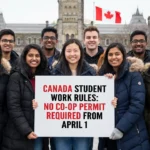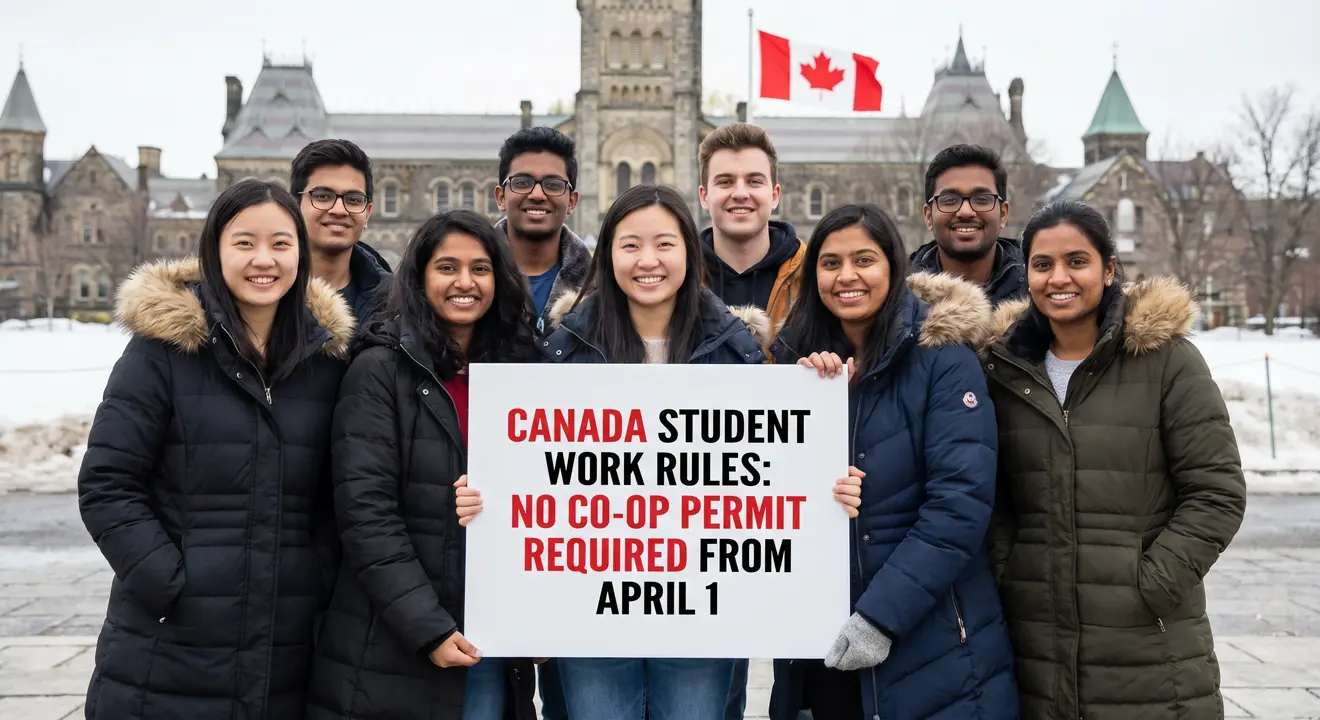
Canada has introduced a significant policy change for international students enrolled in co-op and work-integrated learning programs. As of April 1, 2026, eligible post-secondary international students are no longer required to obtain a separate co-op work permit to participate in work placements required by their study program, such as co-op placements, internships, practicums, and mentorship programs.
This change was officially announced by Immigration, Refugees, and Citizenship Canada (IRCC) on April 9, 2026, and is already in effect. The move is designed to simplify the administrative process for international students, reduce paperwork, and streamline IRCC’s operations by removing an outdated requirement.
Previously, international students needed to hold both a valid study permit and a separate co-op work permit to legally participate in mandatory work placements. This two-permit system often caused delays, confusion, and added bureaucratic hurdles for students and educational institutions alike. Under the new rules, a valid study permit with the appropriate work conditions is sufficient authorization for these placements.
Summary of Key Changes
| Feature | Before April 1, 2026 | From April 1, 2026 |
|---|---|---|
| Co-op/Internship Work Authorization | Separate co-op work permit required | Included in valid study permit |
| Number of Permits Required | Two permits (study permit + co-op work permit) | One permit (study permit) |
| Pending Co-op Work Permit Applications | Processed as usual | Automatically withdrawn by IRCC |
| Processing Burden | High administrative load for students and IRCC | Reduced, streamlined process |
| Work Placement Eligibility | Full-time at DLI with valid study permit | Same, plus a letter from DLI confirming work placement is program requirement |
Eligibility Criteria
To benefit from this policy change, international students must meet all of the following conditions:
- Hold a valid study permit (or have applied for an extension before it expired)
- Be a full-time student at a Designated Learning Institution (DLI)
- Be enrolled in a study program that requires a work placement (co-op, internship, practicum, or mentorship) as an integral part of the curriculum. You will not be able to graduate if you do not complete this component
- Obtain a letter from your DLI confirming that the work placement is a requirement of your program
- Ensure that the work placement makes up 50% or less of the total program of study. For example, in a four-year degree program, the work placement cannot exceed 24 months
- Have a study permit that includes a condition or remark allowing on-campus work (since IRCC classifies these placements as on-campus work, with the educational institution as the primary employer)
What If Your Study Permit Lacks On-Campus Work Authorization?
If your valid study permit does not have a condition or remark allowing you to perform on-campus work, you must request an amendment to your study permit. You should also consult with an international student advisor or immigration consultant at your institution for guidance.
How to Prove Your Eligibility
To confirm your eligibility to work without a co-op permit, you will need the following documents readily available:
- Your valid study permit, clearly showing the on-campus work condition.
- An official letter from your DLI, confirming that the work placement is an integral and required part of your academic program, and that it does not exceed 50% of the total program length.
What About Pending Co-op Work Permit Applications?
Students who have already applied for a co-op work permit and have a pending application do not need to take any action. IRCC has stated that all eligible and active co-op work permit applications will be automatically withdrawn.
It is also advised that if you have a co-op work permit application currently in process, you may wish to cancel the application via the IRCC web form. Since IRCC will no longer be issuing co-op work permits or accepting separate co-op work permit applications, students who have applied for a study permit that includes co-op work requirements should continue as normal, as IRCC will still process the application.
Other Proposed Changes Under Consultation
The removal of the co-op work permit requirement is the first step in a broader set of immigration reforms currently under review by the Canadian government. Additional proposals under consultation include:
- Extended work authorization: Allowing international students to work while waiting for a decision on their study permit extension application
- PGWP work authorization: Permitting international graduates to work full-time while waiting for a decision on their Post-Graduation Work Permit (PGWP) application, provided they completed their program and applied before their study permit expired
- Foreign apprentice rules: Removing the study permit requirement for certain foreign apprentices who meet specific conditions in Canada
- Standardized work rules: Clarifying work authorization during scheduled academic breaks
These proposals are still in the consultation phase, and no timeline has been set for their implementation.
Who Is Not Covered by This Change?
Secondary school students are explicitly excluded from this policy change and must still obtain a separate co-op work permit for their work placements.
Additionally, if a student wishes to participate in an internship that is not a requirement of their degree program, that placement is considered off-campus work and is subject to the standard off-campus work limit of 24 hours per week during regular academic terms.
Off-Campus Work Limit Remains 24 Hours Per Week
It is important to note that this policy change does not affect the rules for off-campus employment. The permanent 24-hour weekly limit for off-campus work during regular academic sessions remains in effect. This limit replaced the temporary 40-hour allowance and has been in place since November 2024.
During regularly scheduled breaks (such as summer or winter holidays), eligible students may work full-time off-campus without any hour restrictions.
Special Considerations for Health and Education Fields
Students whose work placements are in the health services field (e.g., nursing, pharmacy students) or in the K-12 education field (e.g., BEd students) must ensure that there are no conditions on their study permit that would restrict them from working in their respective field. If such a condition exists, the student must apply for a study permit extension to have the condition changed.
Social Insurance Number (SIN) Requirements
To work in Canada, you must have a valid Social Insurance Number (SIN). If your SIN has expired because you are on maintained status (i.e., waiting for a decision on your study permit extension), you may still work with your expired SIN. However, if your study permit extension application is refused, you must stop working immediately.
Industry and Educator Reactions
The change has been widely welcomed by the international education sector. Larissa Bezo, president of the Canadian Bureau for International Education (CBIE), called it a “welcome streamlining of the study permit process”. Educators have hailed the update as a positive and practical change that will have a real impact, simplifying the student experience, reducing IRCC processing burdens, and removing an outdated administrative step without increasing work authorization.
Background: Why This Change Was Needed
Under the previous system, international students enrolled in co-op or work-integrated learning programs were required to obtain both a study permit and a work permit to complete their courses in Canada. This created significant administrative burdens for both students and IRCC. As of April 9, 2026, the waiting time for a work permit application from inside Canada was 247 days, reflecting severe visa processing backlogs.
The change follows the publication of the Auditor General’s report, which revealed severe shortcomings in Canada’s International Student Program. Stakeholders had been calling for smarter and more differentiated visa processing to ease delays. By removing the co-op work permit requirement, IRCC aims to reduce administrative burden and operational inefficiency while supporting institutions’ ability to attract top talent by reducing barriers for international students to participate in all elements of their study program.
Frequently Asked Questions (FAQs)
Q: When did this policy change take effect?
A: The change took effect on April 1, 2026, and was officially announced by IRCC on April 9, 2026.
Q: Do I need to apply for anything to be eligible?
A: No separate application is required. As long as you have a valid study permit with on-campus work conditions and a letter from your DLI confirming the work placement is a program requirement, you are authorized to participate.
Q: What happens to my pending co-op work permit application?
A: IRCC will automatically withdraw all eligible and active co-op work permit applications. You do not need to take any action.
Q: Does this apply to secondary school students?
A: No. Secondary school students must still obtain a separate co-op work permit.
Q: Can I work more than 24 hours per week during my co-op term?
A: Since IRCC classifies co-op placements as on-campus work, the 24-hour off-campus limit does not apply. However, you must ensure that your work placement does not exceed 50% of your total program length.
Q: What if my study permit does not have on-campus work conditions?
A: You must request an amendment to your study permit or apply for a study permit extension to have the condition added.
Q: Does this change affect my off-campus work hours?
A: No. The 24-hour weekly limit for off-campus work during regular academic terms remains unchanged.
Final Advice for International Students
This policy change represents a significant simplification for international students enrolled in co-op and work-integrated learning programs. Students should verify that their study permit includes the appropriate on-campus work conditions, obtain the required letter from their DLI confirming the work placement is a program requirement, and ensure their work placement does not exceed 50% of their total program length.
Students with pending co-op work permit applications should monitor their IRCC account for automatic withdrawal notices. Those whose study permits lack on-campus work conditions should take immediate steps to request an amendment or extension.
The key date to remember is April 1, 2026—the day Canada eliminated the separate co-op work permit requirement for eligible post-secondary international students.
Disclaimer: Immigration laws and policies are subject to change. This information is based on IRCC announcements as of April 2026 and is for educational purposes only. Always consult with your institution’s international student office or a qualified immigration advisor for guidance specific to your situation.